It’s been a pretty good week. I’m not sure exactly why (although it could have something to do with a double scoop ice cream cone Wednesday), but I looked up and it was Friday, and I realized I had enjoyed the week. That’s always a blessing, right? I’ve rotated to pharmacy in the clinic for the next couple weeks (although still stepping in to triage or give a shot if they need an extra pair of hands), and it’s a little like stepping back to square one. I’ve never really worked in a pharmacy before, so instead of being helpful right now I’m back to the learning stage – and I’ll say props to all the doctors and pharmacists out there because to me it’s still pretty intimidating looking at the shelves and shelves of medicines and wondering how anyone can remember where they all go and what they do. But again…poco a poco. And it’s a little easier now, because I know Nila and she’s very patient and helpful teaching me. I think I also realize I have to be patient and let myself learn…I suppose that’s a good lesson to remember, huh?
Last week, for some reason, was a little more difficult. Not really in a conscious way or even in a way I could put my finger on, but I guess you go through your ups and downs. I’ve been here two months now (how about that?!) and I guess, whether I’m aware of it or not, I’m hitting the first hump of “I’m in a new culture, a new job, a new environment. And it’s here to stay.” Plus, I think last week my brain and heart got hit with a lot of questions, frustrations, and realities that have been gathering in light of the poverty and disparity I see on a daily basis, and I’m beginning to try to process them. (Emphasis on “beginning” and “trying to” :) ). Not an easy task, but an important one, I think. But you know what? In spite of all that, I am extremely blessed, and there’s nowhere I’d rather be.
Last week there was also a group here from Georgia. It was a small team, but they brought a doctor and a pharmacist, and their presence allowed us to do a couple of campañas – where we set up in more impoverished areas with less access and offer free consults and medicines. One day we went to Los Pinos (near Wichanzao) and another we drove to Magdalena de Cao, a quiet town about an hour away. It was nice to get a little change in scenery and responsibility and to get my first glimpse at how the campañas work.
In other news, yesterday was the first day of spring here. (Happy Spring!) The occasion provided an acceptable excuse for a rather lively party at the institute next door (although catchy to listen to, the music delayed sleep for awhile), and apparently there will be a parade Sunday afternoon, so it’s fun to see those celebrations. And you’ll never guess – last week, not one, but two mornings we awoke to actual sunshine streaming in through the windows. Sunshine in the morning…would you believe it? Novel concept. But I think as spring continues to blossom, we’ll get more than just our few hours of afternoon winter sunshine. Ojalá… And I have to say I’m looking forward to it. Bring on the sunshine!
Friday, September 24, 2010

Friday, September 17, 2010
Consultorio Medico Pastoral
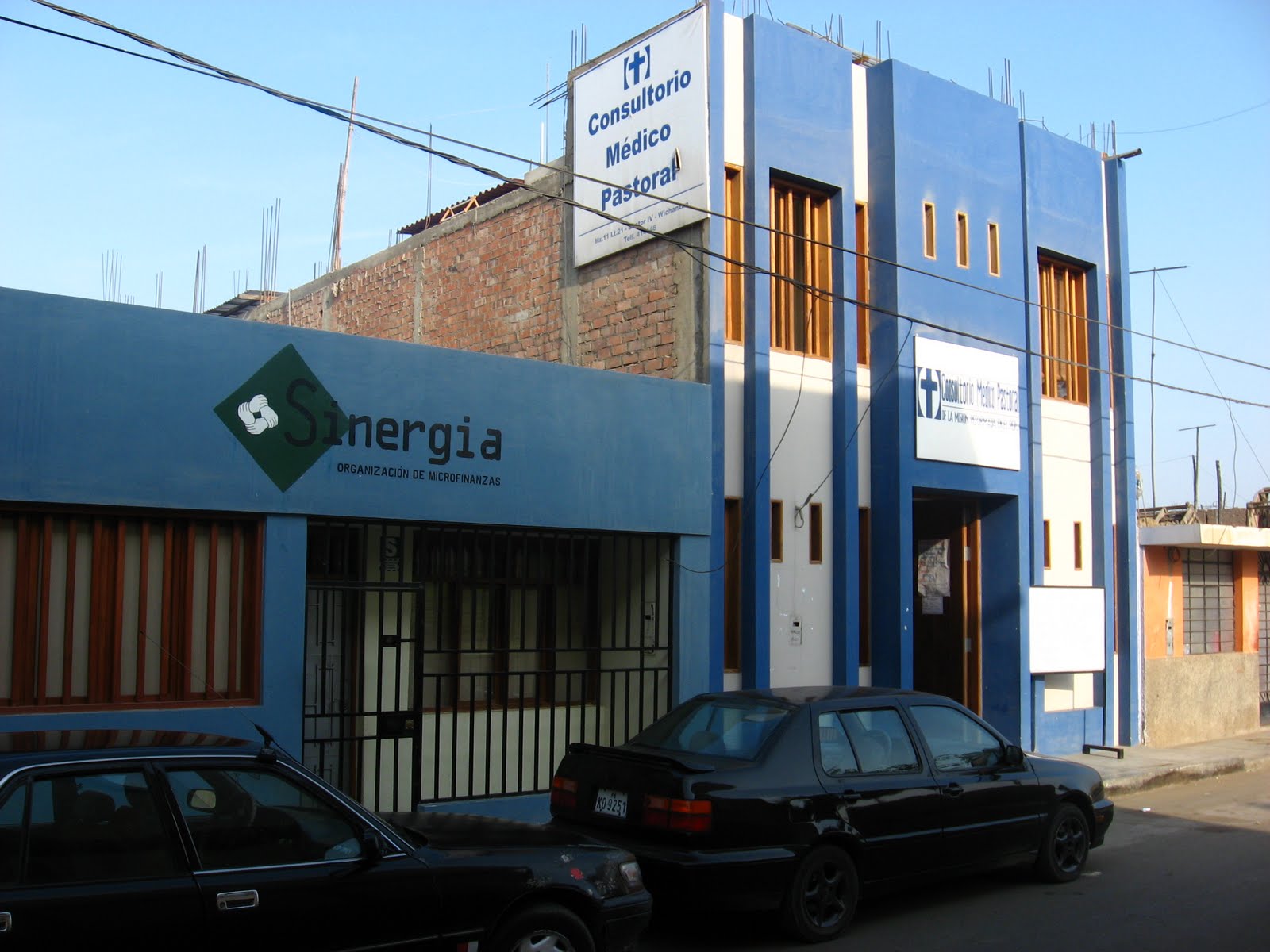
CMP – this is where I work in Wichanzao every morning from 8 to about 12:30. You get off the colectivo at Corli (which has been paved within the past year), take a left, a right, another left, and then you’re there. It’s across from the Wichanzao Presbyterian Church and next to Sinergia, Peru Mission’s microfinance program. The clinic used to be in the church, and they built this building about 3 years ago.
The clinic is open from 8 to 5 Monday through Thursday, and until 2 on Fridays and 12 on Saturdays. It’s a primary care clinic where people from Wichanzao (or any of the surrounding areas: Trujillo, Arevalo, Clementina, Los Pinos, Las Palmeras…) can come for quality care and medications at an affordable price. Most patients can see a doctor for about 7 soles ($2.50), and the medications, from what I’ve heard, are much cheaper than at most other clinics. I think the price of everything is pretty comparable to the government postas, but the care is much better and you don’t have to get there as early or wait as long.
One of the things I’ve enjoyed most is working with the staff. Dr. Julton sees patients every day. He’s a young doctor who just began working in the clinic in March. While I think he’s still learning a lot, he is gaining people’s trust and loyalty, and his humble, reassuring manner with patients is inspiring and reflective of his faith. There are also other doctors who come in during the mornings: Dr. Alfonso on Mondays, Dr. Mario Tuesday through Thursday, and Dr. Ra
 úl on Fridays. They work part time to supplement their other jobs and are a little more popular since they’ve been around longer, but I think Dr. Julton is becoming more known and trusted by patients.
We also have Dr. Angel, the dentist. Daniel, the other intern working at the clinic, is helping him, and the two of them together are a mess. Lots of personality and dry humor flying around, and Dr. Angel is fluent in rudimentary Spanglish. That to say he tries to throw out English words and sentences all the time, with varying degrees of success. It’s certainly entertaining, though, and when he found out my last night was Rice (arroz in Spanish), he immediately started calling me “Lydia Rice…rice with chicken!” harkening to the typical Peruvian dish arroz con pollo.
Sonia is the obstetrician, but she only sees patients three days a week as she is also the clinic manager. So she does double duty and coordinates a lot with Dale Ellison, the missionary who is administrator over the clinic (and completes the current gringo trio at CMP). Sonia’s really good, though, and I’ve enjoyed getting to talk with her a little and see how well she does her job. I hope I get to know her better as the year goes on.
Nila is a nurse who is usually in charge of the pharmacy and most days comes and grabs me to come get a cup of coffee and a little
 snack of conchitas or empanada. She’s kind of like a favorite grandmother-figure. Jenny signs people in and takes out their medical histories, Kelvin is the lab tech, and Marina is a sweet, quiet lady who keeps everything looking clean and great. Noemí and Cynthia are the nurses (I work a lot with them, at least so far), and we triage patients, give shots, administer nebulizations, cut gauze, sterilize instruments, etc. Of course, they have some more qualified responsibilities as well that I can often watch or help with, and they’re very generous and patient to explain things to me.
There are a wide variety of patients who come through, and I enjoy getting to see most of them in triage, even if but for a moment. Some people are well off and don’t have problems paying, but the hard part is when you know they do. The clinic has a fund that helps cover treatment and medicines for people who can’t afford it, but even so I’m sure there are people who struggle to meet the costs. And I’m sure there are people who don’t come at all for fear that they can’t afford it. Honestly (and un
 fortunately), even if they did all come, we probably couldn’t fully cover the costs of everyone who couldn’t pay. Because, even though Peru Mission makes up for what the clinic loses each month, it seems like there’s always an end to the funds. As much as I would love to believe otherwise, frustratingly everything still comes down to dollars and cents…or soles y céntimos. I guess there’s a balance between looking at how to improve what needs fixing and being encouraged and joyful at each victory. Because, in truth, there are plenty of both.
Monday, September 6, 2010
Trujillo Traffic and Transportation
Traffic in Trujillo is an adventure. Sometimes there are lanes dividing traffic, but often these are just a formality. It’s quite expected for cars, buses, and taxis to weave in and out of one another to squeeze to the front of the pack or get to the curb quickly to drop off or pick up a passenger. And cutting in front of someone is no reason to get offended – that guy’s just doing what the next guy will do to him in 12 seconds, and no one seems to mind. The fun part is the intersections that don’t have traffic lights…but somehow the big jam of cars in the middle all seem to get across, with some well-practiced combination of taking turns and forcing their way through. The amazing part is, there are probably fewer wrecks with all this would-be bedlam than there are in the States. At any rate, traffic moves a lot more reliably than on I-65 in Birmingham, that’s for sure.
Transportation is also pretty exciting. Taxis are cheap, and you can take a car full of people between most places in the city for 3 or 4 soles (just over $1). For destinations along one of the set routes, there are a number of options, including (in descending order of size) micros (normal-sized buses), combis (big vans, similar to the VW variety), and colectivos (a 5-seated sedan). Most of these have seen better days and have lots of character, and all of them will squeeze in as many people as possible.
Colectivos are my transportation of choice on the way to and from the clinic each day. I take the “B” route, and for 1.20 soles (about 40 cents) one way, you can get out to Wichanzao on the Panamerican highway in about 15 minutes. Well, maybe 20 if traffic is heavy or if your driver stops at every person standing on the curb to see if they want “la B” heading out of town. It’s kind of like a big game of Chinese fire drill, with the driving pulling over to let people out or pick people up at their desired stop. It’s not at all uncommon for the colectivo to reach its full capacity of seven people (4 passengers in the back, 2 up front with the driver), and as you extract yourself from the pile, you have to smile as you realize you’ve been closer to these strangers than you have been to many of your closest friends. Gotta love Perú. J
Transportation is also pretty exciting. Taxis are cheap, and you can take a car full of people between most places in the city for 3 or 4 soles (just over $1). For destinations along one of the set routes, there are a number of options, including (in descending order of size) micros (normal-sized buses), combis (big vans, similar to the VW variety), and colectivos (a 5-seated sedan). Most of these have seen better days and have lots of character, and all of them will squeeze in as many people as possible.
Colectivos are my transportation of choice on the way to and from the clinic each day. I take the “B” route, and for 1.20 soles (about 40 cents) one way, you can get out to Wichanzao on the Panamerican highway in about 15 minutes. Well, maybe 20 if traffic is heavy or if your driver stops at every person standing on the curb to see if they want “la B” heading out of town. It’s kind of like a big game of Chinese fire drill, with the driving pulling over to let people out or pick people up at their desired stop. It’s not at all uncommon for the colectivo to reach its full capacity of seven people (4 passengers in the back, 2 up front with the driver), and as you extract yourself from the pile, you have to smile as you realize you’ve been closer to these strangers than you have been to many of your closest friends. Gotta love Perú. J
Thursday, September 2, 2010
Patience, not Complacence
Each month when SALI classes end, we have Thursday and Friday off before the next month’s cycle begins. Last weekend was our first long weekend, but I decided to stay around Trujillo to relax, spend time with people, and see a few things around town. There were also a couple of people I wanted to see who were supposed to come into the clinic on Thursday, and I didn’t want to miss our Friday home visits to patients.
However, I was a little disappointed. On Thursday, Jenny didn’t bring in Ana, her 22-month-old who needs therapy to correct a misaligned hip in order to be able to walk. Neither did we see César, the 3-year-old whose family Noemí and I visited in Clementina last week. He had a fungus on his hand, and although he was taking some medicine from the government posta de salud, we wanted him to come in when he’d finished it to see how he was doing. Fridays are usually a little slower, but last Friday kept a steady pace, and Noemí couldn’t get away to go out on visits.
So I didn’t get to see most of the people I was hoping to. That’s my favorite part of the clinic so far, or at least the thing I really want to start focusing on: keeping up with patients we see on a regular basis, building relationships with them, and making sure they are getting what they need. I’ve loved getting to go out a couple of times, too, and see them in their homes, where they actually live.
Now that I’ve been working here a month and feel a little more settled, I hope I can do more of that. Although I was a little frustrated not getting to do some of that last week, I realized that I need to be patient. I think I’m learning the need for that with a lot of things here. I don’t need to force things to happen – sometimes I think the best opportunities come when we’re not expecting them, or trying too hard. And I need to be patient, too, because although I am anxious to be active and useful, I have only been working at the clinic four weeks.
At the same time, though, I don’t want to be complacent. It could be tempting to passively go about my work and responsibilities and ya está – that’s it, that’s done, move on to the next thing. But that wouldn’t be very beneficial to the patients, to the clinic’s ministry, or to me. I think I’m at the point where I hopefully can start deciding ways to be more actively involved, and I’m praying to be open to seeing what those opportunities are. Maybe that means, when the line of triage patients slows down, going out to a couple of houses and checking on people we haven’t heard from, or who could just do with a visitor. I kind of hope so.
Today, I went back and saw Cesar and his mother Neida in Clementina. His hand is improving but he now has something on his eye. She said she would bring him into the clinic this afternoon. Poco a poco...

César and his mischievous smile.

César and his mischievous smile.
Sunday, August 29, 2010
Friendship
Time is funny…days are long, but the weeks are really starting to fly. In some ways, it seems like I’ve been in Trujillo for much longer than I have, and in others it’s hard to believe it has already been over a month. But there is a little bit of a rhythm now, to my work in the clinic and at SALI – and at the same time, a big part of life’s rhythm right now is that there is none at all. :)
Last Sunday was Rachel and Patrick’s birthday. Rachel wanted to have some people over to celebrate, so we invited some of our Peruvian friends and told them to spread the word for those who were interested. We ended up having a pretty big crowd show up, with an interesting mixture of people from SALI (language school), SUSA (Friday night young adult ministry), the downtown Cristo Rey church, or people who just hang around with that group. Honestly, I wasn’t sure I was up for hosting a big crowd of people at the apartment, but I ended up having a really good time, and it was fun to see Rachel enjoying herself. It’s nice to feel special, especially on your birthday.
People hung out for quite awhile munching on snacks (I think I could eat my weight in guacamole), enjoying a cheesecake made by Alleen (one of the missionaries down here in charge of the interns and also fun to hang out with), and generally enjoying one another’s company. Inevitably, after awhile someone broke out the salsa music and, since a few of the guys really know what they’re doing, space was cleared on the floor for some dancing.
One of my favorite parts, though, was a Peruvian tradition where people basically go around and say nice things about the person whose birthday is being celebrated. I suppose it can get a little cliché, but I was struck by how many people wanted to share how much Rachel already meant to them, even after just 3 weeks. No one was pretending they were already best friends, but several people genuinely encouraged her and told her how they appreciated her talents, qualities, and characteristics. I think we could all use a little dose of that, and not just on our birthdays.
Most of the people I’ve met here are all extremely warm and welcoming. It’s wonderful to have that, and I confess at times I want to rush in and be great friends with someone right away. I certainly feel like I’m making good friends with some cool people (and it’s a little easier because Heidi already has good friends from last year that she’s kind enough to share!), but I also realize that true friendships – at least for me – take time to develop. And I think that’s good, even if it does require a little more patience. I’m thankful for the new relationships I have, and I hope I can keep finding that equilibrium between genuine interest and investment in others and patience enough to allow friendship to develop naturally and deeply…and even to enjoy that process.

Verónica, Rebeca, Maresa, and Rosa singing Happy Birthday to Rachel.
Last Sunday was Rachel and Patrick’s birthday. Rachel wanted to have some people over to celebrate, so we invited some of our Peruvian friends and told them to spread the word for those who were interested. We ended up having a pretty big crowd show up, with an interesting mixture of people from SALI (language school), SUSA (Friday night young adult ministry), the downtown Cristo Rey church, or people who just hang around with that group. Honestly, I wasn’t sure I was up for hosting a big crowd of people at the apartment, but I ended up having a really good time, and it was fun to see Rachel enjoying herself. It’s nice to feel special, especially on your birthday.
People hung out for quite awhile munching on snacks (I think I could eat my weight in guacamole), enjoying a cheesecake made by Alleen (one of the missionaries down here in charge of the interns and also fun to hang out with), and generally enjoying one another’s company. Inevitably, after awhile someone broke out the salsa music and, since a few of the guys really know what they’re doing, space was cleared on the floor for some dancing.
One of my favorite parts, though, was a Peruvian tradition where people basically go around and say nice things about the person whose birthday is being celebrated. I suppose it can get a little cliché, but I was struck by how many people wanted to share how much Rachel already meant to them, even after just 3 weeks. No one was pretending they were already best friends, but several people genuinely encouraged her and told her how they appreciated her talents, qualities, and characteristics. I think we could all use a little dose of that, and not just on our birthdays.
Most of the people I’ve met here are all extremely warm and welcoming. It’s wonderful to have that, and I confess at times I want to rush in and be great friends with someone right away. I certainly feel like I’m making good friends with some cool people (and it’s a little easier because Heidi already has good friends from last year that she’s kind enough to share!), but I also realize that true friendships – at least for me – take time to develop. And I think that’s good, even if it does require a little more patience. I’m thankful for the new relationships I have, and I hope I can keep finding that equilibrium between genuine interest and investment in others and patience enough to allow friendship to develop naturally and deeply…and even to enjoy that process.
Verónica, Rebeca, Maresa, and Rosa singing Happy Birthday to Rachel.

Briggith, Katy, me, and Heidi one night when we had some people over for dinner.

Karina, Heidi, and Maresa when we spent a couple of hours at the beach at Huanchaco, about 20 minutes from Trujillo.
Sunday, August 22, 2010
Poco a poco
Poco a poco – little by little. I heard that a lot from the other staff members my first few days working at the clinic. And it was something I needed to hear. Honestly, the first week there was a little overwhelming. The first day Noemí, one of the nurses, walked me through doing triage with one or two patients, and then I was on my own with them, jumping right in. It felt something comparable to drinking out of a fire hydrant. Not that taking people’s height, weight, and blood pressure is a particularly difficult task. Taking the basic medical histories of new patients is a little more complicated, but even that is basically just completing a form of questions. I was just a little overwhelmed with the prospect of being responsible for documenting each patient’s information correctly. And, because I haven’t actually done this in the States either, most of the protocol or “normal” answers to the medical history questions I’m not even familiar with in English, much less Spanish. Plus, especially at the beginning, I had to learn simple things like how the system of street addresses works or how many checkups a mother is supposed to have during her pregnancy, and I still often have to ask someone how to spell their last name or the town where they were born. So the first few days, I felt more incompetent and in the way than like I was being much of a help.
It’s funny – in the process of raising support to come down here, I learned a lot about being humbled and relying on God and other people. I prayed that this would be a lesson I continued to learn each day when I was down here…and (would you believe it?!) God thought I was serious. J Being in a new environment, a new language, a new system of how people do things, working with new people – all this on top of learning new skills and procedures, even if they are just basic, makes depending on God and others a necessity. I have to be humbled when Noemí answers all my questions, corrects my mistakes, or patiently watches me prepare and then administer a shot at an agonizingly slow and inexperienced pace - in the same time it would probably take her to perform it easily half a dozen times. Or when Jenny, the cashier/secretary, has to spell out to me what she needs me to go ask Dr. Julton, and then how he doesn’t seem bothered at all by having to repeat the answer twice, but rather treats me with the same compassion and full attention he gives each of his patients. Or when Nila, the nurse/pharmacist/sweet-fun-grandmotherly figure comes and asks me every day, “¿ya tomaste un cafecito?” – if I’ve already had my coffee break – and then takes me up for a warm drink, a roll, empanada or papa rellena, and a comforting conversation.
Yes, I’m learning a lot. From the extremely gracious and kind people with whom I work. From the patients, most of whom I only encounter for a few minutes but some of whom I’ve had the privilege (is it a privilege, if they’re coming to receive medical care?) of seeing a few times when they come back for follow-ups or check-ups. From simply walking through Wichanzao, getting to know the neighborhood a little bit, and wanting to – beginning to – see a little more of what life is really like here, not as a tourist but as a resident who is interested in the individuals who live here. Or so I hope. I am beginning to be accustomed and feel more comfortable, at least with the environment and my basic responsibilities. And I hope that, as that continues more and more, that my curiosity and compassion would increase. That I would be genuinely interested in and invested in each person I attend, whether it’s someone I see once for two minutes or someone with whose circumstances I really become familiar by seeing them week after week. So I’ve been there three weeks now, and I feel like I’ve made progress. But sometimes that makes me realize just how far still I need to go. I guess, though, that’s the goal. Day by day, encounter by encounter, mistake by mistake, little victory by little victory, challenge by challenge, smile by smile…poco a poco.
I’ll write more later about what the clinic actually does and how it serves people, so be on the lookout for that. For now, enjoy these few pictures…
 Noemi and I with Señora Victoria, an elderly lady we went to visit about a week ago (see http://www.pmmedicalministry.blogspot.com/ for more on this and other work of the clinic)
It’s funny – in the process of raising support to come down here, I learned a lot about being humbled and relying on God and other people. I prayed that this would be a lesson I continued to learn each day when I was down here…and (would you believe it?!) God thought I was serious. J Being in a new environment, a new language, a new system of how people do things, working with new people – all this on top of learning new skills and procedures, even if they are just basic, makes depending on God and others a necessity. I have to be humbled when Noemí answers all my questions, corrects my mistakes, or patiently watches me prepare and then administer a shot at an agonizingly slow and inexperienced pace - in the same time it would probably take her to perform it easily half a dozen times. Or when Jenny, the cashier/secretary, has to spell out to me what she needs me to go ask Dr. Julton, and then how he doesn’t seem bothered at all by having to repeat the answer twice, but rather treats me with the same compassion and full attention he gives each of his patients. Or when Nila, the nurse/pharmacist/sweet-fun-grandmotherly figure comes and asks me every day, “¿ya tomaste un cafecito?” – if I’ve already had my coffee break – and then takes me up for a warm drink, a roll, empanada or papa rellena, and a comforting conversation.
Yes, I’m learning a lot. From the extremely gracious and kind people with whom I work. From the patients, most of whom I only encounter for a few minutes but some of whom I’ve had the privilege (is it a privilege, if they’re coming to receive medical care?) of seeing a few times when they come back for follow-ups or check-ups. From simply walking through Wichanzao, getting to know the neighborhood a little bit, and wanting to – beginning to – see a little more of what life is really like here, not as a tourist but as a resident who is interested in the individuals who live here. Or so I hope. I am beginning to be accustomed and feel more comfortable, at least with the environment and my basic responsibilities. And I hope that, as that continues more and more, that my curiosity and compassion would increase. That I would be genuinely interested in and invested in each person I attend, whether it’s someone I see once for two minutes or someone with whose circumstances I really become familiar by seeing them week after week. So I’ve been there three weeks now, and I feel like I’ve made progress. But sometimes that makes me realize just how far still I need to go. I guess, though, that’s the goal. Day by day, encounter by encounter, mistake by mistake, little victory by little victory, challenge by challenge, smile by smile…poco a poco.
I’ll write more later about what the clinic actually does and how it serves people, so be on the lookout for that. For now, enjoy these few pictures…
Noemi and I with Señora Victoria, an elderly lady we went to visit about a week ago (see http://www.pmmedicalministry.blogspot.com/ for more on this and other work of the clinic) This is a view of the clinic from outside - Consultorio Medico Pastoral.
 Lunch with some of the clinic staff (Daniel - dental student/fellow intern with me; Angel - dentist at the clinic who always gives me a hard time; Nila; Dale - clinic administrator and missionary with Peru Mission; Noemi) at the end of the second week. My first ceviche after they found out that I had yet to try this typical Peruvian dish.
Thursday, August 19, 2010
A Different Kind of Beautiful
I think I've mentioned that one of the best parts of being here so long is actually living here - making my own routines or fitting in what I know as normal to make it seem a little more like home. For example, usually when I travel, I don't slow down much. I like to try to see and experience as much as possible because I know I'm only there for a limited period of time. While my time here is still limited, it's long enough that I can go home and get to bed early a night or two a week, or I can spend a Saturday skyping, catching up on emails, cooking, shopping, playing soccer, hanging out, etc. It's nice to take that as a Sabbath, to be able to actually rest and not feel like I am missing out by having a more relaxed day.

That being said, last Saturday was not quite as uneventful as the previous couple had been. I ended up going with Tyler and Seth out to Wichanzao (the area of town where the clinic is) to climb the mountain Serro de Cabros that had been teasing and enticing us since the first time the smog and clouds cleared out enough to tell that there are actually mountains around Trujillo. Despite loving not having to do things on the weekends, it was really nice to get out and do something a little different. Like the rest of this area, the mountain is extremely dry. In fact, it's pretty much all sand, rock, and shale. It's stark and looming (although not incredibly high), and its steep areas and lack of green make it look like the set of an old western movie where you might expect a pack of cowboys to come galloping by in a cloud of dust.
 I think we took the hard way, at least at the beginning as we clambered between huge rock structures, but even when we reached the
 more open (but still steep) spaces higher up, the paths that seemed evident from the bottom where hard to find. I guess the slightly different shade of dirt that makes them visible isn't as easy to distinguish when you see it up close. (I'm sure there's a profoud metaphor somewhere in there). The only live things we saw were a few bugs, a couple of lizards, a struggling cactus, a bunch of snail-like creatures that looked like you should have found them at the beach, and a tiny, scrawny coyote that scrambled past a few dozen yards below us when we were taking a break.


That being said, last Saturday was not quite as uneventful as the previous couple had been. I ended up going with Tyler and Seth out to Wichanzao (the area of town where the clinic is) to climb the mountain Serro de Cabros that had been teasing and enticing us since the first time the smog and clouds cleared out enough to tell that there are actually mountains around Trujillo. Despite loving not having to do things on the weekends, it was really nice to get out and do something a little different. Like the rest of this area, the mountain is extremely dry. In fact, it's pretty much all sand, rock, and shale. It's stark and looming (although not incredibly high), and its steep areas and lack of green make it look like the set of an old western movie where you might expect a pack of cowboys to come galloping by in a cloud of dust.
 I think we took the hard way, at least at the beginning as we clambered between huge rock structures, but even when we reached the
 more open (but still steep) spaces higher up, the paths that seemed evident from the bottom where hard to find. I guess the slightly different shade of dirt that makes them visible isn't as easy to distinguish when you see it up close. (I'm sure there's a profoud metaphor somewhere in there). The only live things we saw were a few bugs, a couple of lizards, a struggling cactus, a bunch of snail-like creatures that looked like you should have found them at the beach, and a tiny, scrawny coyote that scrambled past a few dozen yards below us when we were taking a break.
Despite the stark environment, it was beautiful in its own way. And arriving at the top you could look one way and see how expansive Trujillo actually is, with houses and buildings flung for miles east toward the ocean (which we couldn't see because of the haze). The amazing part, though, was looking west. From the top you could see more mountains that aren't visible from the bottom of the mountain or through the haze of the city. But above it all, looking at their beauty (even more impressive and imposing than our "Goat Mountain"), it was exciting to think about how far they stretch. I'm not sure that these are even technically part of the Andes. Maybe they're just the beginning, but it sure made you wonder what beauty and adventure lies beyond what you can see. Sounds a little like Pocahontas... :)


One of my favorite parts was actually getting to the mountain. You had to walk a good 20 or 30 minutes through Wichanzao and then the poorer area of Clementina to reach the base of the mountain. It was really interesting and eye-opening to walk through the area where people lived, to get a glimpse of the reality - even if from outside their walls - of what life is like for these Peruvians. It's probably similar to that of many people I see in the clinic every day. It's by no means the poorest place in the world, but it's still a reality check. Kids playing soccer, dozens of dogs wandering around, women washing and hanging clothes, people bringing buckets of water...just another Saturday. And equally - if not more - beautiful here.
But God forbid that I ever romanticize it.


Subscribe to:
Posts (Atom)